
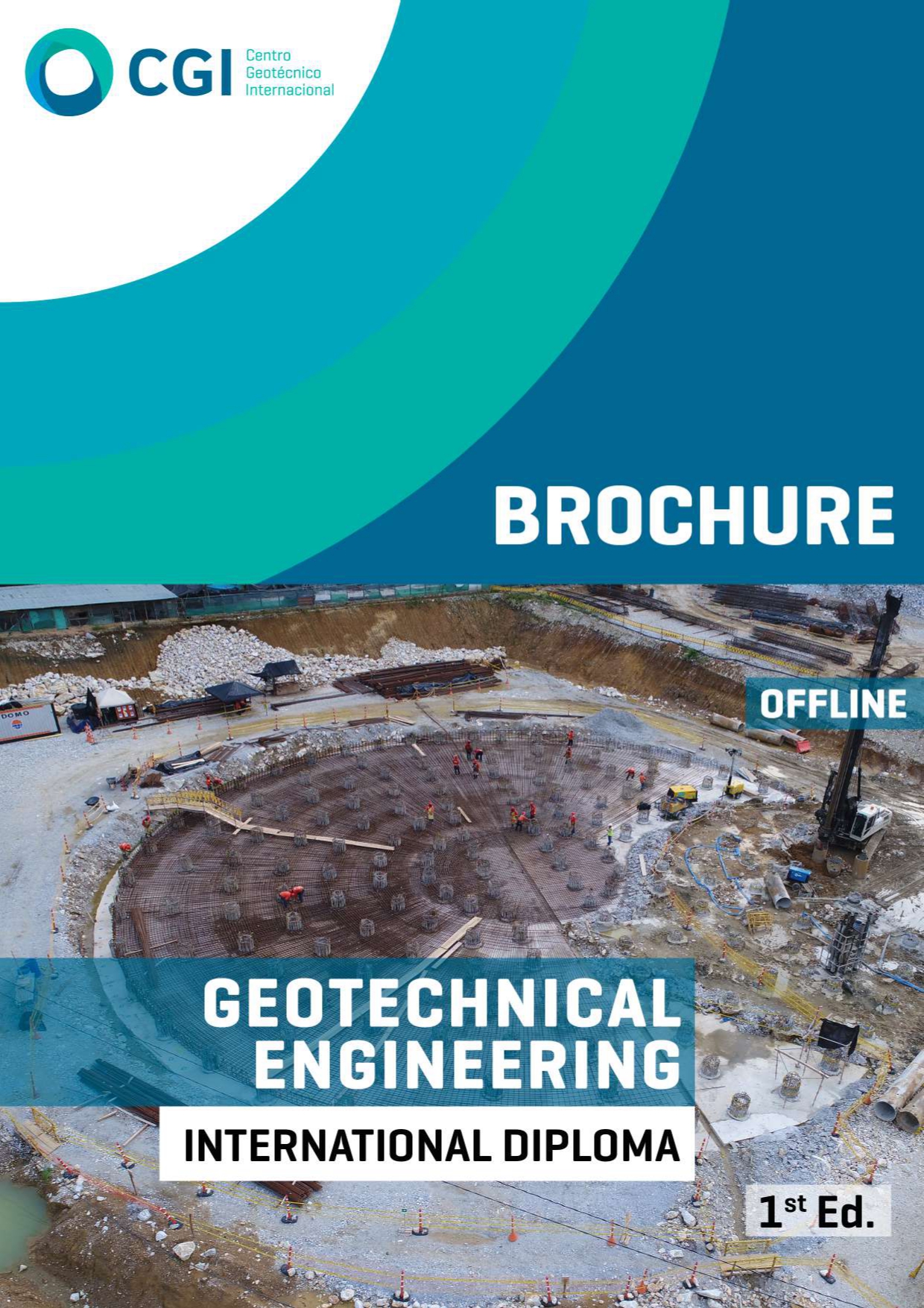
 DIPLOMA GEOTECHNICAL ENGINEERING
BRIEF SUMMARY
Proper characterization of the geological environment is essential when planning any type of structure. The design of a foundation, the stability of a slope, the excavation of a tunnel, or the construction of a dam depend primarily on the behavior of the terrain and its interaction with the structure.
This diploma aims to establish in the student a solid knowledge base in geotechnical engineering, enabling them to approach project engineering in a practical and realistic manner. Through the study of terrain recognition techniques, evaluation of its geotechnical parameters, and examination of various calculation methodologies and relevant geotechnical aspects, the necessary requirements are provided to propose different construction solutions efficiently.
TRAINING MODALITY
The modality presented is the “Virtual-OFFLINE” (Virtual asynchronous); in this you will develop a course every 30 days, which is made up of videos, materials, slides and questions to the speaker. At the end of each course, you must take an exam to pass it and move on to the next course.
You will be assigned the tutoring of a specialist and there will be no limitations in terms of access hours or consultations with the speaker, this promotes that you be trained efficiently. The hours dedicated to each module must be managed assertively to optimize the benefit. You will experience all of the above through our virtual campus, which will also allow us to monitor your progress.
SYLLABUS:
► Module 1: Introduction to geotechnical engineering, field reconnaissance and laboratory tests
► Module 2: Soil Mechanics
► Module 3:: Rock Mechanics
► Module 4: Foundations (shallow and deep) and containment structures
► Module 5: Slope Stability in soils and rocks
► Module 6: Tunnels and underground excavations
► Module 7: Embankments (earth structures) and Dams
► Module 8: Hydrology and Applied Hydrology
► Module 9: Thesis project
PARTICIPANTS:
Professionals and technicians who work in mining, construction and/or energy companies and are working in the areas of engineering, rock engineering, rock mechanics, planning, geotechnics, geomechanics, geology, mining safety and professionals who require greater knowledge her.
Likewise, professionals from mining contracting companies, infrastructure, consultants, university professors and students and the general public who are involved in the topic.
TESTIMONIALS
The teacher manages the topics covered in this course perfectly, his lectures are very theoretical and at the same time practical.
Cynthia, Yauli Cuadrado
Hydrogeology - Hydrogeologist
Klohn Crippen Berger
Peru
A really great course that develops the general and necessary aspects of the laboratory data analysis procedure.
Hugo Ivan, Sereno Villaseñor
College Student
Universidad Latina de América
Mexico
Really good. It has exceeded what I was looking for from the course since a I learned to use the software correctly and in a really clear way.
Erick Antonio, Brenes Rodríguez
Operations - Manager
Tecnosolum Consultores Geotécnicos
Costa rica
Excellent course, you can learn many things each day, the theoretical is put into practice in the day to day of the working day.
Fausto Grover, Valentin Japa
Geomechanics - Geomechanical Engineer
Cía Minera KOLPA
Peru
CERTIFICATION
►Certificate of approval for each module and diploma of the complete Diploma issued by the International Geotechnical Center.
►Certificates and diplomas do not indicate the training modality.
► Each diploma has a unique identification code to verify its authenticity.
STARTING DATE
►The diploma is available at any time. The start dates of the course will depend on your time availability.
DURATION
► 11 month) 8-month modules + 3 months dissertation)
ACADEMIC HOURS
►315 academic hours
Request more information about the Diploma:
Click here to view the Diploma brochure
Best regards,
International Geotechnical Center - CGI
CGI PERU: ✆ Cellphone-Whatsapp:(51) 987 392 885
CGI CHILE: ✆ Telephone:(56) 232109658
CGI MEXICO: ✆ Telephone:(52) 5541708066
CGI ARGENTINA: ✆ Telephone:(54) 1152188717
CGI USA: ✆ Telephone:(1) 3473445811 information@centrogeotecnico.com
centrogeotecnico.com
Lima - Peru
PRESENTATION
Proper characterization of the geological environment is essential when planning any type of structure. The design of a foundation, the stability of a slope, the excavation of a tunnel, or the construction of a dam depend primarily on the behavior of the terrain and its interaction with the structure.
This diploma aims to establish in the student a solid knowledge base in geotechnical engineering, enabling them to approach project engineering in a practical and realistic manner. Through the study of terrain recognition techniques, evaluation of its geotechnical parameters, and examination of various calculation methodologies and relevant geotechnical aspects, the necessary requirements are provided to propose different construction solutions efficiently.
BENEFITS
► Receive certificates and a diploma in the name of the International Geotechnical Center - IGC.
► Learn from a speaker with extensive experience in the subject.
► Receive slides and materials for each module.
► Access and view video classes of the modules through the CGI Virtual Campus.
► Have the ability to make academic inquiries through the CGI Virtual Campus forum as needed.
► Access the modules from wherever you are via your computer and the internet.
► Enjoy a privileged perspective on classes compared to an in-person diploma program.
SYLLABUS
► Module 1: Introduction to geotechnical engineering, field reconnaissance and laboratory tests
► Module 2: Soil Mechanics
► Module 3:: Rock Mechanics
► Module 4: Foundations (shallow and deep) and containment structures
► Module 5: Slope Stability in soils and rocks
► Module 6: Tunnels and underground excavations
► Module 7: Embankments (earth structures) and Dams
► Module 8: Hydrology and Applied Hydrology
► Module 9: Thesis project
TRAINING MODALITY
The modality presented is the “Virtual-OFFLINE” (Virtual asynchronous); in this you will develop a course every 30 days, which is made up of videos, slideshows, materials and questions to the speaker.
At the end of every module, the student must take an exam to pass it and move on to the next course.
You will be assigned the tutoring of a specialist and there will be no limitations in terms of access hours or consultations with the speaker, this promotes that you train efficiently.The hours dedicated to each module must be managed assertively to optimize the benefit.
You will experience all of the above through our virtual campus, which will also allow us to monitor your progress.
PARTICIPANTS:
Professionals and technicians who work in mining, construction and/or energy companies and are working in the areas of engineering, rock engineering, rock mechanics, planning, geotechnics, geomechanics, geology, mining safety and professionals who require greater knowledge her.
Likewise, professionals from mining contracting companies, infrastructure, consultants, university professors and students and the general public who are involved in the topic.
TESTIMONIALS
The teacher manages the topics covered in this course perfectly, his lectures are very theoretical and at the same time practical.
Cynthia, Yauli Cuadrado
Hydrogeology - Hydrogeologist
Klohn Crippen Berger
Peru
A really great course that develops the general and necessary aspects of the laboratory data analysis procedure.
Hugo Ivan, Sereno Villaseñor
College Student
Universidad Latina de América
Mexico
Really good. It has exceeded what I was looking for from the course since a I learned to use the software correctly and in a really clear way.
Erick Antonio, Brenes Rodríguez
Operations - Manager
Tecnosolum Consultores Geotécnicos
Costa rica
Excellent course, you can learn many things each day, the theoretical is put into practice in the day to day of the working day.
Fausto Grover, Valentin Japa
Geomechanics - Geomechanical Engineer
Cía Minera KOLPA
Peru
COSTS, SYLLABUS, OTHERS:
To serve you correctly, we handle several quotes that are based on the various needs of our clients.
We have implemented an automated system that will take care of you. We would appreciate it if you register and the system will automatically send you to your email:
► Brochure of the diploma (modality, duration, curriculum, others).
► Quotation of the diploma course (costs, means of payment, forms of financing, others).
► Immediate free access to a DEMO course in the virtual campus so that you can have an experience of it.
REGISTRATION FORM: Diploma Registration Form
NOTE: This registration will not generate any commitment with our institution, the objective is to be able to send you the information of the diploma course.
NEWSLETTER
If you like, you can also keep up to date with our activities and free contributions through our Message Center by entering here: http://goo.gl/qtmrHi
Best regards,
International Geotechnical Center - CGI
CGI PERU: ✆Telephone:(511) 485-1540 / 642-9705, Cellphone-Whatsapp:(51) 923 065 359
CGI CHILE: ✆ Telephone:(56) 232109658
CGI MEXICO: ✆ Telephone:(52) 5541708066
CGI ARGENTINA: ✆ Telephone:(54) 1152188717
CGI USA: ✆ Telephone:(1) 3473445811
✉ information@centrogeotecnico.
www.centrogeotecnico.com
Lima – Peru

- Gerente: Raquel Quiroz CGI
- Professor: Guillermo RODRIGUEZ CAYLLAHUA
BRIEF SUMMARY
The first module of the Geotechnical Engineering Diploma program consists of defining what geotechnical engineering is and its scope of application. The importance of the geological-geotechnical model and the geotechnical study will be evaluated as fundamental tools for the appropriate design of construction projects. In the second part, we will study how to conduct a geotechnical investigation campaign, learning about the types of in-situ reconnaissance and tests carried out in the field, as well as the main types of laboratory tests performed on both soils and rocks.TRAINING OBJECTIVES
► Understand the importance of the geological-geotechnical model and the geotechnical study as essential elements of the construction project.
►Be able to assess the scope of a geotechnical investigation campaign.
►Identify the sources of information that should be consulted to develop a geotechnical study.
►Learn about the different types of field reconnaissance conducted in an investigation campaign, including geophysical prospecting methods, drilling, test pits, penetration tests, etc.
►Distinguish and analyze the various types of laboratory tests performed on samples obtained during the field campaign, including tests on soils and rocks.
BENEFITS
► Access to the International Diploma in Geotechnical Engineering.
► Get trained by a speaker with vast experience on the subject.
►Receive materials for each module such as slides, manuals and data that you can keep.
► Freedom to access a course on the day and at the time you want, as well as to pause and go back the class as many times as necessary until you fully assimilate the knowledge that is provided.
► Access to the network of professionals from various countries of the world. Technicians, university students, engineers, masters, doctors, post-doctors and the general public related to the professional field participate in our diploma course.
► Access to the database of queries and answers from the participants, as well as the technical reports generated in each module and the supporting theses.
TRAINING MODALITY
The modality presented is the “Virtual-OFFLINE” (Virtual asynchronous); in this you will develop a course every 30 days, which is made up of videos, materials, slides and questions to the speaker. At the end of each course, you must take an exam to pass it and move on to the next course.
You will be assigned the tutoring of a specialist and there will be no limitations in terms of access hours or consultations with the speaker, this promotes that you be trained efficiently. The hours dedicated to each module must be managed assertively to optimize the benefit. You will experience all of the above through our virtual campus, which will also allow us to monitor your progress.
PARTICIPANTS:
This diploma is aimed at professionals and technicians who work in mining, construction and/or energy companies and are working in the areas of engineering, planning, geotechnics, geomechanics, geology, mining safety and professionals who require a deeper knowledge of it.
Also professionals from mining contractors, infrastructure companies, consulting firms, university porfessors, students and the general public involved in the subject.
SYLLABUS
UNIT 1: Introduction to Geotechnical Engineering
UNIT 2: Geotechnical Investigation Campaign; Field Reconnaissance and Laboratory Tests
TESTIMONIALS
Enrolled in different diplomas:The teacher manages the topics covered in this course perfectly, his lectures are very theoretical and at the same time practical.
Cynthia, Yauli Cuadrado
Hydrogeology - Hydrogeologist
Klohn Crippen Berger
Peru
A really great course that develops the general and necessary aspects of the laboratory data analysis procedure.
Hugo Ivan, Sereno Villaseñor
College Student
Universidad Latina de América
Mexico
Really good. It has exceeded what I was looking for from the course since a I learned to use the software correctly and in a really clear way.
Erick Antonio, Brenes Rodríguez
Operations - Manager
Tecnosolum Consultores Geotécnicos
Costa rica
Excellent course, you can learn many things each day, the theoretical is put into practice in the day to day of the working day.
Fausto Grover, Valentin Japa
Geomechanics - Geomechanical Engineer
Cía Minera KOLPA
Peru
Request more information about the Diploma:
Click here to view the Diploma brochure
Best regards,
International Geotechnical Center - CGI
CGI PERU: ✆Telephone:(511) 485-1540 / 642-9705, Cellphone-Whatsapp:(51) 923 065 359
CGI CHILE: ✆ Telephone:(56) 232109658
CGI MEXICO: ✆ Telephone:(52) 5541708066
CGI ARGENTINA: ✆ Telephone:(54) 1152188717
CGI USA: ✆ Telephone:(1) 3473445811 information@centrogeotecnico.
www.centrogeotecnico.com
Lima - Peru

- Gerente: Raquel Quiroz CGI
- Professor: Guillermo RODRIGUEZ CAYLLAHUA
BRIEF SUMMARY
Module 2 of the Geotechnical Engineering Diploma program provides students with the basic concepts of soil mechanics. In the first part, the types of soils are described and how they should be characterized and classified. Subsequently, the behavior of stresses in the ground and the phenomena that occur are evaluated, introducing the basic concept of effective stress. Similarly, the different soil failure mechanisms are presented, analyzing the concepts of cohesion and friction angle as fundamental soil parameters and the laboratory tests conducted to determine them. We will study the soil consolidation process and, finally, the types of problematic soils that can be encountered when designing an engineering project.TRAINING OBJECTIVES
► Understand the different types of soils, their classification, and their main geotechnical characteristics.
► Define how stresses act in soils and the various phenomena that occur in the presence of water.
► Be able to evaluate the different parameters that define the strength and deformation of soils, including cohesion and friction angle.
► Learn about the various consolidation processes that soils undergo, including the oedometer test.
► Distinguish between the different types of problematic soils commonly encountered in geotechnics, such as expansive, collapsible, dispersive, and liquefiable soils.
BENEFITS
► Access to the International Diploma in Geotechnical Engineering.
► Get trained by a speaker with vast experience on the subject.
►Receive materials for each module such as slides, manuals and data that you can keep.
► Freedom to access a course on the day and at the time you want, as well as to pause and go back the class as many times as necessary until you fully assimilate the knowledge that is provided.
► Access to the network of professionals from various countries of the world. Technicians, university students, engineers, masters, doctors, post-doctors and the general public related to the professional field participate in our diploma course.
► Access to the database of queries and answers from the participants, as well as the technical reports generated in each module and the supporting theses.
TRAINING MODALITY
The modality presented is the “Virtual-OFFLINE” (Virtual asynchronous); in this you will develop a course every 30 days, which is made up of videos, materials, slides and questions to the speaker. At the end of each course, you must take an exam to pass it and move on to the next course.
You will be assigned the tutoring of a specialist and there will be no limitations in terms of access hours or consultations with the speaker, this promotes that you be trained efficiently. The hours dedicated to each module must be managed assertively to optimize the benefit. You will experience all of the above through our virtual campus, which will also allow us to monitor your progress.
PARTICIPANTS:
This diploma is aimed at professionals and technicians who work in mining, construction and/or energy companies and are working in the areas of engineering, planning, geotechnics, geomechanics, geology, mining safety and professionals who require a deeper knowledge of it.
Also professionals from mining contractors, infrastructure companies, consulting firms, university porfessors, students and the general public involved in the subject.
SYLLABUS
► UNIT 1: Origin and formation of soils
► UNIT 2: Characterization and classification of soils
► UNIT 3: Stresses in soil
► UNIT 4: Strength and Deformation of Soils
► UNIT 5: Determination of strength
► UNIT 6: Soil consolidation
► UNIT 7: Problematic soils
TESTIMONIALS
Enrolled in different diplomas:The teacher manages the topics covered in this course perfectly, his lectures are very theoretical and at the same time practical.
Cynthia, Yauli Cuadrado
Hydrogeology - Hydrogeologist
Klohn Crippen Berger
Peru
A really great course that develops the general and necessary aspects of the laboratory data analysis procedure.
Hugo Ivan, Sereno Villaseñor
College Student
Universidad Latina de América
Mexico
Really good. It has exceeded what I was looking for from the course since a I learned to use the software correctly and in a really clear way.
Erick Antonio, Brenes Rodríguez
Operations - Manager
Tecnosolum Consultores Geotécnicos
Costa rica
Excellent course, you can learn many things each day, the theoretical is put into practice in the day to day of the working day.
Fausto Grover, Valentin Japa
Geomechanics - Geomechanical Engineer
Cía Minera KOLPA
Peru
Request more information about the Diploma:
Click here to view the Diploma brochure
Best regards,
International Geotechnical Center - CGI
CGI PERU: ✆Telephone:(511) 485-1540 / 642-9705, Cellphone-Whatsapp:(51) 923 065 359
CGI CHILE: ✆ Telephone:(56) 232109658
CGI MEXICO: ✆ Telephone:(52) 5541708066
CGI ARGENTINA: ✆ Telephone:(54) 1152188717
CGI USA: ✆ Telephone:(1) 3473445811 information@centrogeotecnico.
www.centrogeotecnico.com
Lima - Peru

- Gerente: Raquel Quiroz CGI
- Professor: Guillermo RODRIGUEZ CAYLLAHUA
►BRIEF SUMMARY
The diploma course in Rock Mechanics will provide theoretical and practical knowledge related to the study of rock masses and discontinuities, with the objective of understanding the behavior of stresses and deformations when performing subway and/or surface excavations. At the end of the course diploma,the participant will understand the phenomena that affect rock masses and will be able to give recommendations to maintain the stability of the excavations. Knowledge will be reinforced through workshops using specialized software.The course will offer you a basic, intermediate and advance level to specialize in rock mechanics applied to subway and surface excavations such as tunnels, mining slopes, waste and tailings deposits, geomechanical design for minig, civil and energy industries.
You will have the facility yo review or learn the basic of the subject and then delve into its more specific points, so you will benefit from your new knowledge founded on a theorical basis, and developed in practice through the various workshops that the diploma course contains.
TRAINING OBJECTIVES
►Describe, quantify, and analyze the physical, mechanical, strength, and deformability properties of rocks for engineering purposes.
►Apply stereographic and statistical analyses in the processing of structural discontinuity orientation data.
►Understand in detail the process of rock mass characterization for classification, sizing, analysis, design, and/or modeling of surface or underground excavations.
BENEFITS
► Access to the International Diploma in Geotechnical Engineering
► Get trained by a speaker with vast experience on the subject.
►Receive materials for each module such as slides, manuals and data that you can keep.
► Freedom to access a course on the day and at the time you want, as well as to pause and go back the class as many times as necessary until you fully assimilate the knowledge that is provided.
► Access to the network of professionals from various countries of the world. Technicians, university students, engineers, masters, doctors, post-doctors and the general public related to the professional field participate in our diploma course.
► Access to the database of queries and answers from the participants, as well as the technical reports generated in each module and the supporting theses.
TRAINING MODALITY
The modality presented is the “Virtual-OFFLINE” (Virtual asynchronous); in this you will develop a course every 30 days, which is made up of videos, materials, slides and questions to the speaker. At the end of each course, you must take an exam to pass it and move on to the next course.
You will be assigned the tutoring of a specialist and there will be no limitations in terms of access hours or consultations with the speaker, this promotes that you be trained efficiently. The hours dedicated to each module must be managed assertively to optimize the benefit. You will experience all of the above through our virtual campus, which will also allow us to monitor your progress.
PARTICIPANTS:
This diploma is aimed at professionals and technicians who work in mining, construction and/or energy companies and are working in the areas of engineering, planning, geotechnics, geomechanics, geology, mining safety and professionals who require a deeper knowledge of it.
Also professionals from mining contractors, infrastructure companies, consulting firms, university porfessors, students and the general public involved in the subject.
SYLLABUS
UNIT 1: Introduction to rock mechanics
UNIT 2: Geomechanical characterization for engineering purposes
UNIT 3: Introduction to rock laboratory testing
UNIT 4: Stability analysis of surface and undergroud excavations in mining
TESTIMONIALS
Enrolled in different diplomas:The teacher manages the topics covered in this course perfectly, his lectures are very theoretical and at the same time practical.
Cynthia, Yauli Cuadrado
Hydrogeology - Hydrogeologist
Klohn Crippen Berger
Peru
A really great course that develops the general and necessary aspects of the laboratory data analysis procedure.
Hugo Ivan, Sereno Villaseñor
College Student
Universidad Latina de América
Mexico
Really good. It has exceeded what I was looking for from the course since a I learned to use the software correctly and in a really clear way.
Erick Antonio, Brenes Rodríguez
Operations - Manager
Tecnosolum Consultores Geotécnicos
Costa rica
Excellent course, you can learn many things each day, the theoretical is put into practice in the day to day of the working day.
Fausto Grover, Valentin Japa
Geomechanics - Geomechanical Engineer
Cía Minera KOLPA
Peru
Request more information about the Diploma:
Click here to view the Diploma brochure
Best regards,
International Geotechnical Center - CGI
CGI PERU: ✆Telephone:(511) 485-1540 / 642-9705, Cellphone-Whatsapp:(51) 923 065 359
CGI CHILE: ✆ Telephone:(56) 232109658
CGI MEXICO: ✆ Telephone:(52) 5541708066
CGI ARGENTINA: ✆ Telephone:(54) 1152188717
CGI USA: ✆ Telephone:(1) 3473445811 information@centrogeotecnico.
www.centrogeotecnico.com
Lima - Peru

- Gerente: Raquel Quiroz CGI
- Professor: Guillermo RODRIGUEZ CAYLLAHUA
►BRIEF SUMMARY
The diploma describes the various types of foundations and retaining structures found in civil works and building construction. Additionally, it introduces basic concepts for calculating allowable stress and settlements for different types of soils, both for shallow and deep foundations, analyzing how stresses are distributed in the soil. The module also covers the various types of retaining walls and flexible structures (such as diaphragms), and the types of earth pressures they are subjected to. We will study common solutions used for foundations located in complex geological conditions.TRAINING OBJECTIVES
► Understand the different types of foundations and retaining structures, their classification, and their main characteristics.
► Define how stresses in the soil vary when a foundation is applied and the various earth pressure phenomena that occur in retaining structures.
► Be able to evaluate the different calculations required to determine the allowable pressure and settlements of the soil based on geotechnical parameters.
► Understand the various types of soil treatments for foundations in complex geological conditions.
BENEFITS
► Access to the International Diploma in Geotechnical Engineering
► Get trained by a speaker with vast experience on the subject.
►Receive materials for each module such as slides, manuals and data that you can keep.
► Freedom to access a course on the day and at the time you want, as well as to pause and go back the class as many times as necessary until you fully assimilate the knowledge that is provided.
► Access to the network of professionals from various countries of the world. Technicians, university students, engineers, masters, doctors, post-doctors and the general public related to the professional field participate in our diploma course.
► Access to the database of queries and answers from the participants, as well as the technical reports generated in each module and the supporting theses.
TRAINING MODALITY
The modality presented is the “Virtual-OFFLINE” (Virtual asynchronous); in this you will develop a course every 30 days, which is made up of videos, materials, slides and questions to the speaker. At the end of each course, you must take an exam to pass it and move on to the next course.
You will be assigned the tutoring of a specialist and there will be no limitations in terms of access hours or consultations with the speaker, this promotes that you be trained efficiently. The hours dedicated to each module must be managed assertively to optimize the benefit. You will experience all of the above through our virtual campus, which will also allow us to monitor your progress.
PARTICIPANTS:
This diploma is aimed at professionals and technicians who work in mining, construction and/or energy companies and are working in the areas of engineering, planning, geotechnics, geomechanics, geology, mining safety and professionals who require a deeper knowledge of it.
Also professionals from mining contractors, infrastructure companies, consulting firms, university porfessors, students and the general public involved in the subject.
SYLLABUS
UNIT 1: Concept and criteria for selecting the type of foundation
UNIT 2: Shallow foundations
UNIT 3: Deep foundations
UNIT 4: Foundations in complex geological conditions
UNIT 5: Retaining structures
TESTIMONIALS
Enrolled in different diplomas:The teacher manages the topics covered in this course perfectly, his lectures are very theoretical and at the same time practical.
Cynthia, Yauli Cuadrado
Hydrogeology - Hydrogeologist
Klohn Crippen Berger
Peru
A really great course that develops the general and necessary aspects of the laboratory data analysis procedure.
Hugo Ivan, Sereno Villaseñor
College Student
Universidad Latina de América
Mexico
Really good. It has exceeded what I was looking for from the course since a I learned to use the software correctly and in a really clear way.
Erick Antonio, Brenes Rodríguez
Operations - Manager
Tecnosolum Consultores Geotécnicos
Costa rica
Excellent course, you can learn many things each day, the theoretical is put into practice in the day to day of the working day.
Fausto Grover, Valentin Japa
Geomechanics - Geomechanical Engineer
Cía Minera KOLPA
Peru
Request more information about the Diploma:
Click here to view the Diploma brochure
Best regards,
International Geotechnical Center - CGI
CGI PERU: ✆Telephone:(511) 485-1540 / 642-9705, Cellphone-Whatsapp:(51) 923 065 359
CGI CHILE: ✆ Telephone:(56) 232109658
CGI MEXICO: ✆ Telephone:(52) 5541708066
CGI ARGENTINA: ✆ Telephone:(54) 1152188717
CGI USA: ✆ Telephone:(1) 3473445811 information@centrogeotecnico.
www.centrogeotecnico.com
Lima - Peru

- Gerente: Raquel Quiroz CGI
- Professor: Guillermo RODRIGUEZ CAYLLAHUA
►BRIEF SUMMARY
The aim is for the participant to be able to identify and characterize different geomaterials based on their nature, origin, mechanical behavior, and hydraulic properties. This includes conducting stability analyses based on various movement mechanisms. From this foundation, participants will be able to propose suitable stabilization methods for both soils and rocks and understand the importance of these geological processes from the perspective of Comprehensive Disaster Risk Management.
TRAINING OBJECTIVES
► The geotechnical characterization and description of geomaterials both in the field and in the laboratory
► The physics of slope instability processes
► The evaluation of the forces involved and the use of commercial software
► The design and selection of appropriate stabilization methods
► The implementation of plans or programs focused on Comprehensive Disaster Risk Management
BENEFITS
► Access to the International Diploma in Geotechnical Engineering
► Get trained by a speaker with vast experience on the subject.
►Receive materials for each module such as slides, manuals and data that you can keep.
► Freedom to access a course on the day and at the time you want, as well as to pause and go back the class as many times as necessary until you fully assimilate the knowledge that is provided.
► Access to the network of professionals from various countries of the world. Technicians, university students, engineers, masters, doctors, post-doctors and the general public related to the professional field participate in our diploma course.
► Access to the database of queries and answers from the participants, as well as the technical reports generated in each module and the supporting theses.
TRAINING MODALITY
The modality presented is the “Virtual-OFFLINE” (Virtual asynchronous); in this you will develop a course every 30 days, which is made up of videos, materials, slides and questions to the speaker. At the end of each course, you must take an exam to pass it and move on to the next course.
You will be assigned the tutoring of a specialist and there will be no limitations in terms of access hours or consultations with the speaker, this promotes that you be trained efficiently. The hours dedicated to each module must be managed assertively to optimize the benefit. You will experience all of the above through our virtual campus, which will also allow us to monitor your progress.
PARTICIPANTS:
This diploma is aimed at professionals and technicians who work in mining, construction and/or energy companies and are working in the areas of engineering, planning, geotechnics, geomechanics, geology, mining safety and professionals who require a deeper knowledge of it.
Also professionals from mining contractors, infrastructure companies, consulting firms, university porfessors, students and the general public involved in the subject.
SYLLABUS
UNIT 1: Topic 1: Introduction to Slope Stability Analysis
UNIT 2: Field Sampling Methods and Laboratory Analysis
UNIT 3: Slope Stability in Soils
UNIT 4: Slope Stability in Rocks
UNIT 5: Stability of Earth Retaining Structures
UNIT 6: Introduction to Risk Analysis for Slope Instability
TESTIMONIALS
Enrolled in different diplomas:The teacher manages the topics covered in this course perfectly, his lectures are very theoretical and at the same time practical.
Cynthia, Yauli Cuadrado
Hydrogeology - Hydrogeologist
Klohn Crippen Berger
Peru
A really great course that develops the general and necessary aspects of the laboratory data analysis procedure.
Hugo Ivan, Sereno Villaseñor
College Student
Universidad Latina de América
Mexico
Really good. It has exceeded what I was looking for from the course since a I learned to use the software correctly and in a really clear way.
Erick Antonio, Brenes Rodríguez
Operations - Manager
Tecnosolum Consultores Geotécnicos
Costa rica
Excellent course, you can learn many things each day, the theoretical is put into practice in the day to day of the working day.
Fausto Grover, Valentin Japa
Geomechanics - Geomechanical Engineer
Cía Minera KOLPA
Peru
Request more information about the Diploma:
Click here to view the Diploma brochure
Best regards,
International Geotechnical Center - CGI
CGI PERU: ✆Telephone:(511) 485-1540 / 642-9705, Cellphone-Whatsapp:(51) 923 065 359
CGI CHILE: ✆ Telephone:(56) 232109658
CGI MEXICO: ✆ Telephone:(52) 5541708066
CGI ARGENTINA: ✆ Telephone:(54) 1152188717
CGI USA: ✆ Telephone:(1) 3473445811 information@centrogeotecnico.
www.centrogeotecnico.com
Lima - Peru

- Gerente: Raquel Quiroz CGI
- Professor: Guillermo RODRIGUEZ CAYLLAHUA
►BRIEF SUMMARY
implementation and design of metro and road tunnels. To achieve this, the module will address the elements that lead to selecting underground works as a technical alternative in the definition and implementation of infrastructure in both urban and non-urban environments. It will cover modern principles for tunnel design, the various existing construction methods, contracting forms, and their association with risk management methodologies.
TRAINING OBJECTIVES
To discuss introductory aspects of geotechnical engineering for underground works. This includes discussing feasibility aspects, basic design concepts, identifying the types of underground works and their associated construction methods, as well as aspects related to the contracting of underground works.BENEFITS
► Access to the International Diploma in Geotechnical Engineering
► Get trained by a speaker with vast experience on the subject.
►Receive materials for each module such as slides, manuals and data that you can keep.
► Freedom to access a course on the day and at the time you want, as well as to pause and go back the class as many times as necessary until you fully assimilate the knowledge that is provided.
► Access to the network of professionals from various countries of the world. Technicians, university students, engineers, masters, doctors, post-doctors and the general public related to the professional field participate in our diploma course.
► Access to the database of queries and answers from the participants, as well as the technical reports generated in each module and the supporting theses.
TRAINING MODALITY
The modality presented is the “Virtual-OFFLINE” (Virtual asynchronous); in this you will develop a course every 30 days, which is made up of videos, materials, slides and questions to the speaker. At the end of each course, you must take an exam to pass it and move on to the next course.
You will be assigned the tutoring of a specialist and there will be no limitations in terms of access hours or consultations with the speaker, this promotes that you be trained efficiently. The hours dedicated to each module must be managed assertively to optimize the benefit. You will experience all of the above through our virtual campus, which will also allow us to monitor your progress.
PARTICIPANTS:
This diploma is aimed at professionals and technicians who work in mining, construction and/or energy companies and are working in the areas of engineering, planning, geotechnics, geomechanics, geology, mining safety and professionals who require a deeper knowledge of it.
Also professionals from mining contractors, infrastructure companies, consulting firms, university porfessors, students and the general public involved in the subject.
SYLLABUS
UNIT 1: Introduction
- Eras of technological development
- General aspects of tunnels and underground works in urban and non-urban environments
UNIT 2: Why underground?
- Why choose underground works?
- Feasibility examples
UNIT 3: Design principles
- Ground reaction curve
- Modern principles for the design of tunnels and underground works
UNIT 4: Types of underground works and construction methodologies
- Introduction
- Excavation methods in soil
- Excavation methods in rock
UNIT 5: Contracting and risk management
- Contracting
- Risk management
TESTIMONIALS
Enrolled in different diplomas:The teacher manages the topics covered in this course perfectly, his lectures are very theoretical and at the same time practical.
Cynthia, Yauli Cuadrado
Hydrogeology - Hydrogeologist
Klohn Crippen Berger
Peru
A really great course that develops the general and necessary aspects of the laboratory data analysis procedure.
Hugo Ivan, Sereno Villaseñor
College Student
Universidad Latina de América
Mexico
Really good. It has exceeded what I was looking for from the course since a I learned to use the software correctly and in a really clear way.
Erick Antonio, Brenes Rodríguez
Operations - Manager
Tecnosolum Consultores Geotécnicos
Costa rica
Excellent course, you can learn many things each day, the theoretical is put into practice in the day to day of the working day.
Fausto Grover, Valentin Japa
Geomechanics - Geomechanical Engineer
Cía Minera KOLPA
Peru
Request more information about the Diploma:
Click here to view the Diploma brochure
Best regards,
International Geotechnical Center - CGI
CGI PERU: ✆Telephone:(511) 485-1540 / 642-9705, Cellphone-Whatsapp:(51) 923 065 359
CGI CHILE: ✆ Telephone:(56) 232109658
CGI MEXICO: ✆ Telephone:(52) 5541708066
CGI ARGENTINA: ✆ Telephone:(54) 1152188717
CGI USA: ✆ Telephone:(1) 3473445811 information@centrogeotecnico.
www.centrogeotecnico.com
Lima - Peru

- Gerente: Raquel Quiroz CGI
- Professor: Guillermo RODRIGUEZ CAYLLAHUA
►BRIEF SUMMARY
Module 7 of the Diploma in Geotechnical Engineering is divided into two parts. The first part aims to describe what an embankment is, identifying its structure and the different types of materials that compose it, as well as the various phases of its execution. We will study how to construct embankments under adverse geotechnical conditions, on soft soils, and on mid-slopes.
Additionally, we will cover dams, defining their various types and associated auxiliary structures. We will discuss the types of geotechnical investigations that need to be conducted, studying in detail the key criteria for their proper execution and foundation, as well as the various ground treatments that are performed and the different possible failure mechanisms.
TRAINING OBJECTIVES
► Understand what an embankment is, its structure, how the different types of materials that compose it are classified, and its phases of execution.
►Study how to execute an embankment in adverse situations, on soft soils or mid-slopes.
►Understand the different types of dams: concrete dams and embankment dams, and types of auxiliary structures.
►Define the type of geotechnical investigation required for the proper characterization of the site where the dam is located, studying in detail the various geotechnical criteria to be considered for its proper execution.
►Study the characteristics of the materials that make up the different parts of an embankment dam.
►Understand the different loads that the foundation of a dam endures, studying the ground treatments performed and the possible failure mechanisms.
BENEFITS
► Access to the International Diploma in Geotechnical Engineering
► Get trained by a speaker with vast experience on the subject.
►Receive materials for each module such as slides, manuals and data that you can keep.
► Freedom to access a course on the day and at the time you want, as well as to pause and go back the class as many times as necessary until you fully assimilate the knowledge that is provided.
► Access to the network of professionals from various countries of the world. Technicians, university students, engineers, masters, doctors, post-doctors and the general public related to the professional field participate in our diploma course.
► Access to the database of queries and answers from the participants, as well as the technical reports generated in each module and the supporting theses.
TRAINING MODALITY
The modality presented is the “Virtual-OFFLINE” (Virtual asynchronous); in this you will develop a course every 30 days, which is made up of videos, materials, slides and questions to the speaker. At the end of each course, you must take an exam to pass it and move on to the next course.
You will be assigned the tutoring of a specialist and there will be no limitations in terms of access hours or consultations with the speaker, this promotes that you be trained efficiently. The hours dedicated to each module must be managed assertively to optimize the benefit. You will experience all of the above through our virtual campus, which will also allow us to monitor your progress.
PARTICIPANTS:
This diploma is aimed at professionals and technicians who work in mining, construction and/or energy companies and are working in the areas of engineering, planning, geotechnics, geomechanics, geology, mining safety and professionals who require a deeper knowledge of it.
Also professionals from mining contractors, infrastructure companies, consulting firms, university porfessors, students and the general public involved in the subject.
SYLLABUS
UNIT 1: Embankments
- Types of Earth Structures
- Design of Earth Structures
- Embankment Construction
- Embankments on Soft Soils
- Embankments on Mid-Slopes
UNIT 2: Dams
- Types of Dams
- Auxiliary Structures
- Phases of Geotechnical Investigation
- Geotechnical Survey
- Seismic Studies
- Geotechnical Geological Criteria for Dam Selection
- Dam Foundations
TESTIMONIALS
Enrolled in different diplomas:The teacher manages the topics covered in this course perfectly, his lectures are very theoretical and at the same time practical.
Cynthia, Yauli Cuadrado
Hydrogeology - Hydrogeologist
Klohn Crippen Berger
Peru
A really great course that develops the general and necessary aspects of the laboratory data analysis procedure.
Hugo Ivan, Sereno Villaseñor
College Student
Universidad Latina de América
Mexico
Really good. It has exceeded what I was looking for from the course since a I learned to use the software correctly and in a really clear way.
Erick Antonio, Brenes Rodríguez
Operations - Manager
Tecnosolum Consultores Geotécnicos
Costa rica
Excellent course, you can learn many things each day, the theoretical is put into practice in the day to day of the working day.
Fausto Grover, Valentin Japa
Geomechanics - Geomechanical Engineer
Cía Minera KOLPA
Peru
Request more information about the Diploma:
Click here to view the Diploma brochure
Best regards,
International Geotechnical Center - CGI
CGI PERU: ✆Telephone:(511) 485-1540 / 642-9705, Cellphone-Whatsapp:(51) 923 065 359
CGI CHILE: ✆ Telephone:(56) 232109658
CGI MEXICO: ✆ Telephone:(52) 5541708066
CGI ARGENTINA: ✆ Telephone:(54) 1152188717
CGI USA: ✆ Telephone:(1) 3473445811 information@centrogeotecnico.
www.centrogeotecnico.com
Lima - Peru

- Gerente: Raquel Quiroz CGI
- Professor: Guillermo RODRIGUEZ CAYLLAHUA
►BRIEF SUMMARY
Module 8 of the First Edition of the Diploma in Geotechnical Engineering, or Ground Engineering, is responsible for studying the interaction of constructions with the ground. It is one of the most recent branches of geology and Civil Engineering.
In this module, the mechanical, strength, and hydraulic properties of the materials that compose the ground are studied. These properties are then applied in Civil Engineering, Mining Engineering, or Architecture projects, such as the design of foundations supporting structures like bridges, buildings, or dams.
Within Geotechnics, we can mainly differentiate two fields: Rock Mechanics and Soil Mechanics. To distinguish between soil and rock, we will use the definition provided by Karl Terzaghi, the father of geotechnics and Soil Mechanics.
TRAINING OBJECTIVES
► Develop the Concept of a Watershed and Productive Sectors► Define the scope of the use of groundwater as a complement to surface water.
► Understand the elements of the local hydrogeological model for forecasting groundwater behavior.
► Application of groundwater use and legal regulations.
► Relationship between groundwater and society and economy.
► Evaluation and indirect identification of groundwater locations in arid zones.
BENEFITS
► Access to the International Diploma in Geotechnical Engineering
► Get trained by a speaker with vast experience on the subject.
►Receive materials for each module such as slides, manuals and data that you can keep.
► Freedom to access a course on the day and at the time you want, as well as to pause and go back the class as many times as necessary until you fully assimilate the knowledge that is provided.
► Access to the network of professionals from various countries of the world. Technicians, university students, engineers, masters, doctors, post-doctors and the general public related to the professional field participate in our diploma course.
► Access to the database of queries and answers from the participants, as well as the technical reports generated in each module and the supporting theses.
TRAINING MODALITY
The modality presented is the “Virtual-OFFLINE” (Virtual asynchronous); in this you will develop a course every 30 days, which is made up of videos, materials, slides and questions to the speaker. At the end of each course, you must take an exam to pass it and move on to the next course.
You will be assigned the tutoring of a specialist and there will be no limitations in terms of access hours or consultations with the speaker, this promotes that you be trained efficiently. The hours dedicated to each module must be managed assertively to optimize the benefit. You will experience all of the above through our virtual campus, which will also allow us to monitor your progress.
PARTICIPANTS:
This diploma is aimed at professionals and technicians who work in mining, construction and/or energy companies and are working in the areas of engineering, planning, geotechnics, geomechanics, geology, mining safety and professionals who require a deeper knowledge of it.
Also professionals from mining contractors, infrastructure companies, consulting firms, university porfessors, students and the general public involved in the subject.
SYLLABUS
UNIT 1: Watershed and Hydrogeological Basin
- Hydrological Basin
- Hydrogeological Basin
UNIT 2: Determination and Analysis of Regional Groundwater Flow Patterns
- Determination of Regional Groundwater Flow Patterns
- Analysis of Regional Groundwater Flow Patterns
UNIT 3: Concepts for Hydrological Analysis and Analysis of Hydrometeorological Information
UNIT 4: Methods for Estimating Flow Rates in Surface Water Bodies
- Flow Measurement Methods:
- Volumetric Method
- Parshall Method
- Weir and Orifice Method
- Section-Velocity Method
- ICC Adapted Flow Measurement Method (Section-Velocity Method)
UNIT 5: Geophysical Methods and Groundwater
- Geoelectric Method
- Seismic Method
- Electromagnetic Method
- Gravimetric Method
UNIT 6: Wells, Piezometers, and Monitoring Networks
UNIT 7: Chemical Hydrogeology
UNIT 8: Elements for Local Hydrogeological Modeling
UNIT 9: Environmental Hydrogeology
TESTIMONIALS
Enrolled in different diplomas:The teacher manages the topics covered in this course perfectly, his lectures are very theoretical and at the same time practical.
Cynthia, Yauli Cuadrado
Hydrogeology - Hydrogeologist
Klohn Crippen Berger
Peru
A really great course that develops the general and necessary aspects of the laboratory data analysis procedure.
Hugo Ivan, Sereno Villaseñor
College Student
Universidad Latina de América
Mexico
Really good. It has exceeded what I was looking for from the course since a I learned to use the software correctly and in a really clear way.
Erick Antonio, Brenes Rodríguez
Operations - Manager
Tecnosolum Consultores Geotécnicos
Costa rica
Excellent course, you can learn many things each day, the theoretical is put into practice in the day to day of the working day.
Fausto Grover, Valentin Japa
Geomechanics - Geomechanical Engineer
Cía Minera KOLPA
Peru
Request more information about the Diploma:
Click here to view the Diploma brochure
Best regards,
International Geotechnical Center - CGI
CGI PERU: ✆Telephone:(511) 485-1540 / 642-9705, Cellphone-Whatsapp:(51) 923 065 359
CGI CHILE: ✆ Telephone:(56) 232109658
CGI MEXICO: ✆ Telephone:(52) 5541708066
CGI ARGENTINA: ✆ Telephone:(54) 1152188717
CGI USA: ✆ Telephone:(1) 3473445811 information@centrogeotecnico.
www.centrogeotecnico.com
Lima - Peru

- Gerente: Raquel Quiroz CGI
- Professor: Guillermo RODRIGUEZ CAYLLAHUA